PhD Research
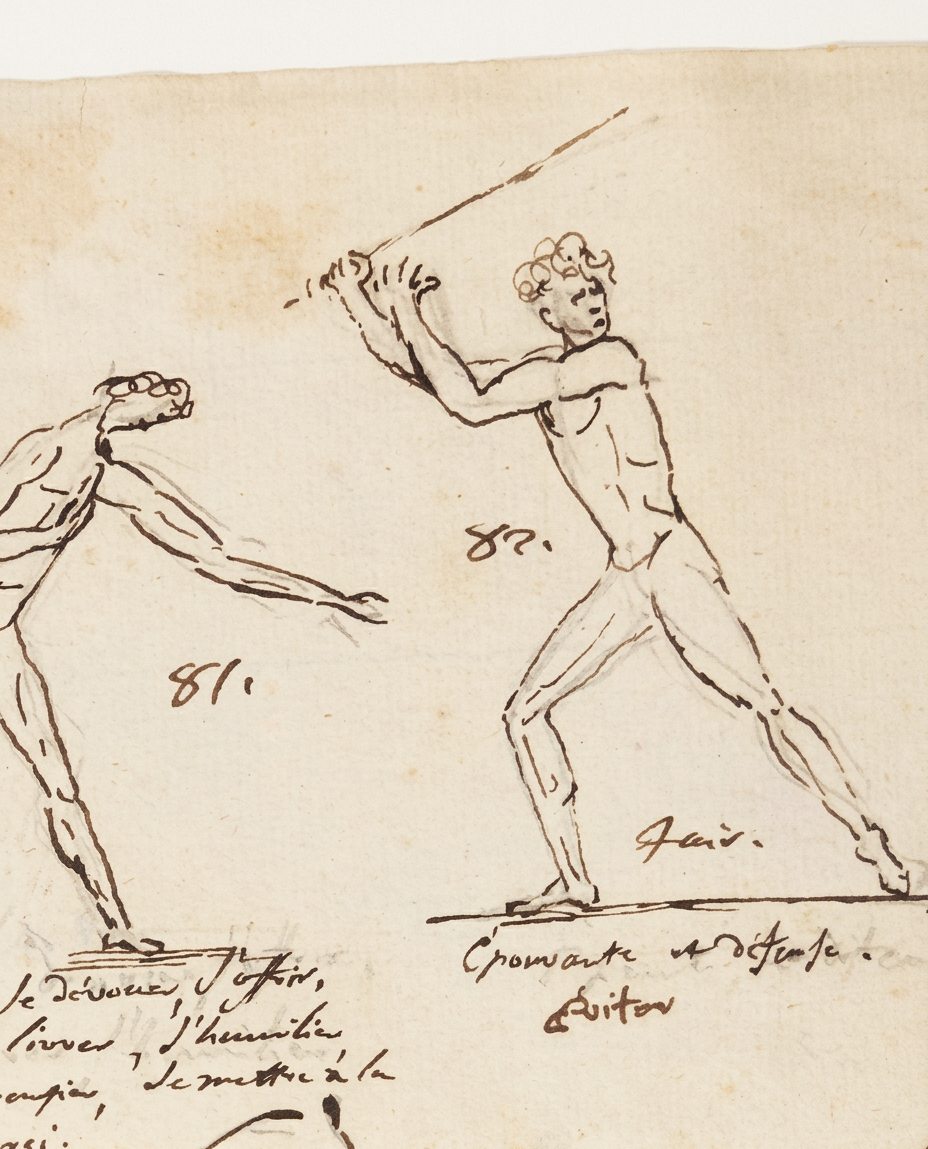
My doctoral project (2026-2029) focuses on the study of a manuscript collection that brings together the drawings of the Italian ballet master, pedagogue, and dance theorist Carlo Blasis (1795-1878). A major figure in the history of Western classical ballet, Blasis profoundly shaped dance education through his theoretical treatises, yet his graphic production remains largely unpublished and understudied. Blasis’ manuscript collection, comprising more than 270 items (drawings, engravings, and printed materials), constitutes the most comprehensive record of his reflections on movement, bringing together over 500 representations of the human body, diagrams, and choreographic studies.
The project’s primary objective is to make this corpus accessible through a critical edition while examining its materiality, organization, functions, and sources of inspiration. Particular attention will be paid to the role of drawing as a means of transmitting technical knowledge in dance, the relationship between graphic visualization and embodied learning, and the connections between artistic practice, Neoclassical visual culture, and the Masonic references that permeate Blasis’s work. The project also seeks to document a practice that was widespread among dance artists in the early nineteenth century: the use of drawing as a tool for thinking about, transmitting, and preserving movement. A codicological and historical analysis will reconstruct the formation of the collection, its material history, and the circumstances surrounding its compilation, while situating the drawings within their author’s biographical, artistic, and cultural context.
Methodologically, the research will combine the systematic indexing of the drawings, formal and iconographic analysis, the study of Blasis’s theoretical writings, and a critical engagement with the work of art and perception theorists. It will also draw upon a perceptual approach informed by somatic and kinesthetic knowledge in order to investigate how the drawings render movement, posture, and bodily dynamics perceptible. Finally, the researcher’s practical experience as both a dancer and dance teacher will inform a ”kinesthetic reading” of the drawings, providing descriptions intended to reactivate the gestures they depict. By doing so, the project aims to bring renewed attention to this previously unpublished corpus and to contribute to scholarship on the history of dance, drawing, and techniques of the body.
Dessinez-vous avec goût et naturellement dans la moindre des poses ; il faut que le danseur puisse, à chaque instant, servir de modèle au peintre, au sculpteur.
Carlo Blasis

